Ethan Allen Firearms in Civil War and Gold Rush Portraits
Ethan Allen Firearms in Civil War and Gold Rush Portraits
This page presents a collection of portraits primarily dating from the American Civil War, together with a small number of earlier photographs from the California Gold Rush era. The subjects are depicted holding pistols or revolvers that have been identified as Ethan Allen firearms.
With the exception of the center-hammer percussion Army revolver, none of these arms was officially adopted by the U.S. military. Instead, they were acquired through private purchase by individual soldiers, civilians, or state militias and were commonly carried as supplementary sidearms.
Most of the images presented here were obtained from publicly accessible websites and online collections. Every effort has been made to identify the firearms accurately; however, in some cases the identification remains tentative because of the quality or angle of the original photographs.
Boy with an Allen & Thurber bar-hammer percussion pistol
Young soldier in Confederate shell jacket and forage cap with Allen & Thurber single shot shotgun-hammer pistol
Soldier with an Allen & Thurber shotgun-hammer boot pistol
Man with an Allen & Thurber double barreled percussion pistol
William Pinkney Cline, Company K, "Catawba Braves", 46th North Carolina Infantry, died May 5, 1864 Fredericksburg VA. Here pictured with an Allen double barrel pistol
A Confederate rebel armed with a large Bowie knife and an Allen & Thurber Barhammer pistol
A young man with a fashionable tie, armed with an Allen & Thurber Barhammer pistol
Texas Jack Vermillion with an Allen & Thurber single shot shotgun hammer pistol
Civil War soldier Sullivan Ballou with musket and an Allen & Thurber single shot barhammer pistol
An unidentified soldier wearing a Confederate uniform, displaying a secession badge and carrying an Allen & Thurber shotgun-hammer boot pistol tucked into his trousers
Jayhawker John Doy (seated) shortly after being liberated by fellow members of the Free State Forces. The second man from the left is wearing a bar-hammer muff pistol around his neck.
Portraits with Allen & Thurber Pepperboxes
Gold rush and frontier men
The pepperbox became the defensive arm of choice for many gold prospectors during the California Gold Rush. Prospectors often worked and traveled in isolated areas, carrying gold dust or freshly mined nuggets that made them attractive targets for thieves, highwaymen, and other opportunistic criminals. Law enforcement was limited or entirely absent in many mining districts, making personal protection a necessity rather than a luxury.
In these conditions, the pepperbox offered a practical and dependable means of self-defense. Its multiple loaded barrels provided several rapid shots without the need to reload, delivering formidable close-range firepower at a time when a single-shot pistol often proved inadequate. For many prospectors, it represented an effective and reassuring safeguard for both their lives and their hard-earned property.
California Gold Rush prospector with a shovel and an Allen & Thurber pepperbox tucked into his belt
Heavily armed man carrying a revolver, two pepperboxes, and a rifle
Two California Gold Rush prospectors; One with an Allen & Thurber 6-shot standard pepperbox
Frontiersman, circa 1847, with a pepperbox tucked into his belt
A well-armed and determined looking California Gold Rush prospector carrying a revolver and an Allen & Thurber pepperbox
Cival War
Although the pepperbox was never a standard military sidearm, it did see limited service during the American Civil War as a privately purchased weapon. Soldiers, officers, cavalrymen, and civilians accompanying the armies occasionally carried pepperboxes in addition to their issued arms, valuing them for the reassurance of having multiple shots immediately available.
The pepperbox was not intended for accurate fire at extended distances. Its short barrel length, rudimentary sights, and heavy trigger pull limited its practical accuracy, making it less effective than contemporary revolvers for most military purposes. Nevertheless, at very close range it could deliver a rapid succession of powerful shots without reloading. In confined situations—such as hand-to-hand fighting in trenches, assaults on fortifications, or the defense of wagons and camps—these characteristics could make it a formidable defensive weapon. While its military value was limited, the pepperbox offered its owner a compact, reliable means of close-quarters protection when speed of fire was more important than precision.
Two Confederate Soldiers from Tennessee; One holding an Allen & Thurber standard 6 shot pepperbox
Civil War soldier with a shotgun, a sword and two holstered Allen & Thurber pepperboxes
Soldier with an 6-shot Allen & Thurber pepperbox
An Union Infantry man armed with revolver and an Allen & Thurber pepperbox
Confederate "gentleman soldier" with two Allen & Thurber pepperboxes
Soldier holding a small 5 shot Allen pepperbox
A kid hardly dry behind the ears with an Allen & Thurber pepperbox
Young man with an Allen& Thurber six shot Worcester standard six shot pepperbox with fluted barrels
Rare image of an African American soldier carrying an Allen pepperbox in his vest, along with a large shotgun and a Bowie knife
Portraits with Allen & Wheelock Percussion Revolvers
A considerable number of period photographs depict soldiers carrying Allen & Wheelock side-hammer percussion revolvers. By far the most frequently encountered is the Belt model, reflecting its popularity as a privately purchased sidearm during the Civil War. The larger Navy model appears less often, while the smaller Pocket model is only rarely identified in surviving photographs.
Images showing Allen’s center-hammer percussion revolvers are exceptionally scarce. Whether this reflects their comparatively limited production, lower popularity, or simply the chance survival of period photographs remains uncertain, but documented examples are decidedly uncommon.
Two Civil War soldiers armed with Allen & Wheelock Side-Hammer Belt revolvers
Corporal Peter Morse, Co.F, 2nd regiment Michigan Volunteers Cavalry holding an Allen & Wheelock Center Hammer Army percussion revolver
Unidentified Union soldier with an Allen & Wheelock Side-Hammer Navy revolver
Second Lt. William Rhodes of Co.B.8th Regt Infantry, Mass.Vol. Militia armed with an Allen & Wheelock Side-Hammer Navy revolver
Only 15 years old when he enlisted in 1862, Private Ephraim Kale, Co. I , Catawba Marksmen, 49th NC State Troops holding an Allen & Wheelock Side-Hammer Belt revolver
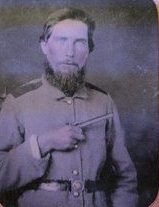
A serious looking Confederate soldier with an Allen & Wheelock Side-Hammer Belt revolver
Soldier with an Allen & Wheelock Side-Hammer Pocket revolver
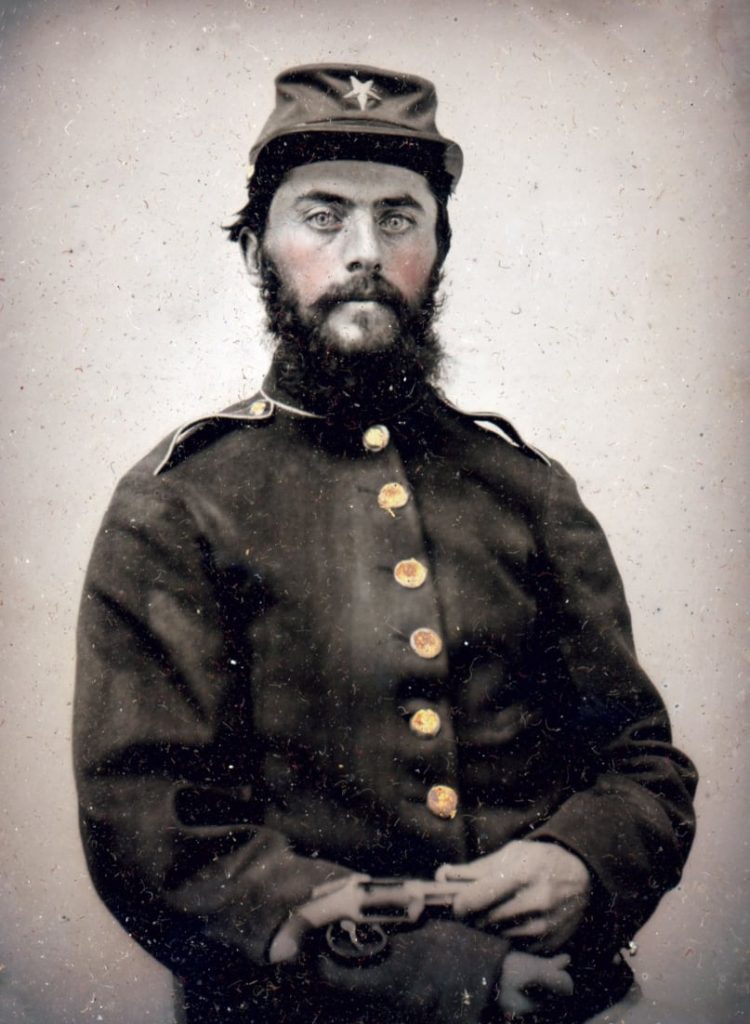
Civil War Union soldier with an Allen & Wheelock Side-Hammer Belt revolver
A rare image from a Union soldier with an Allen & Wheelock large frame Bar-Hammer revolver
Stephen Ellis, Second Lieutenant, Co.I, 31st Alabama Infantry, CSA, 1862, holding an Allen & Wheelock side-hammer belt revolver
Young private with an Allen & Wheelock Side-Hammer Belt Revolver
Soldier with Allen & Wheelock Side-Hammer Belt revolver
Man showing an Allen & Wheelock Side-Hammer Belt revolver
John Wesley Duren form Company I of the 4th Texas Infantry showing his Allen & Wheelock barhammer revolver
Massachusetts Light Artillery crew with Allen & Wheelock Side-Hammer Navy Revolvers
Portraits with Allen & Wheelock Cartridge Revolvers
The vast majority of surviving photographs depict soldiers carrying Allen & Wheelock cartridge revolvers of the side-hammer type, chambered in either .32 Rimfire or .22 Rimfire. These revolvers were manufactured in relatively large numbers, which likely accounts for their frequent appearance as privately purchased sidearms in period photographs.
By contrast, photographs showing Allen’s center-hammer lipfire revolvers are exceedingly rare. To date, I have been able to identify only a single confirmed example, making period images of these revolvers among the most desirable and elusive pieces of photographic evidence for collectors and researchers alike.
Soldier from an artillery regiment armed with a first model Allen & Wheelock 32RF side-hammer revolver. Note that the cylinder pin screw is almost falling out.
Soldier of the 26th NY Infantry Regiment with an Allen & Wheelock 2nd model 32RF side-hammer revolver in his belt
Union Soldier wearing a slouch hat holding two revolvers of which a late model Allen & Wheelock side-hammer 22RF revolver
Civil War soldier holding a late model Allen & Wheelock 22RF side-hammer revolver
Young Confederate recruit with a second model Allen & Wheelock side-hammer 22RF revolver
Soldier with an second model Allen & Wheelock 32RF side-hammer revolver
Civil War soldier holding a late model Allen & Wheelock 22RF side-hammer revolver
Man holding a 2nd model Allen & Wheelock 32RF side-hammer revolver
Union soldier Abraham Hoofnail with an Allen & Wheelock side-hammer 32RF revolver and a bowie knife